Sales & customer experience
CRM, Sales, Point of Sale, eCommerce, Marketing, Helpdesk and customer-facing workflows.
Odoo is a suite of business applications that brings everyday operations into one connected environment—from the first customer enquiry to invoicing, fulfilment, service, and reporting.
A connected operating system for your business
Instead of relying on disconnected tools and repeated data entry, Odoo gives teams a shared foundation for customer, product, supplier, employee, and financial information. The goal is not to install every app at once; it is to build a useful operating system around the workflows that matter most to your business.
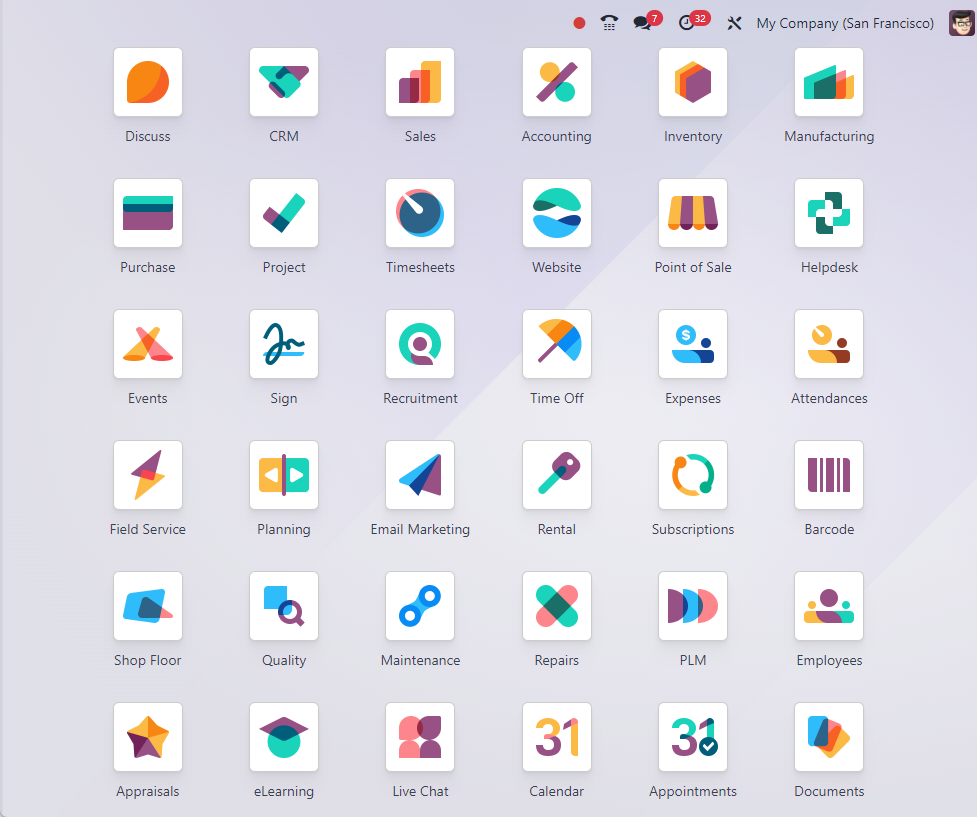
Applications for the work that moves your business
Odoo applications can cover a broad range of functions. The right starting point depends on your processes, priorities, edition, localisation requirements, and selected Odoo version.
CRM, Sales, Point of Sale, eCommerce, Marketing, Helpdesk and customer-facing workflows.
Invoicing, expenses, documents, approvals and accounting capabilities suited to the selected setup.
Purchase, Inventory, Manufacturing, Quality, Maintenance, Field Service and delivery-related processes.
Project, Timesheets, Planning, HR and the operational visibility needed to coordinate teams.
Modular by design
Odoo is designed as a collection of applications that work together. This makes a phased rollout possible—but it also makes thoughtful planning important.
Focus first on the bottlenecks, controls, or customer journeys where a connected process will create the clearest value.
Additional applications can extend the same operational foundation as requirements mature.
Applications and custom modules may rely on one another, so changes should be assessed for their effect on data and existing workflows.
Configuration, upgrades, integrations, and module changes should be validated in a suitable test or staging environment.
Edition, hosting and customisation are connected decisions
The best technical path depends on your functional requirements, internal capabilities, compliance needs, integrations, and long-term ownership model.
Odoo provides Community and Enterprise editions. The available functionality, licence terms, support model, and localisation options should be reviewed for the version and scope you plan to use.
Odoo can be hosted through Odoo’s cloud offerings or in an on-premise environment. The hosting choice affects administration, deployment practices, and whether custom applications are supported.
A tailored solution may combine Odoo configuration with custom development and connections to banks, delivery providers, eCommerce, BI, or other business systems. Each integration needs a clear support and upgrade plan.
How to choose the right Odoo scope
1
Identify how work, approvals, data, and exceptions move across teams today.
2
Prioritise a manageable set of outcomes rather than trying to digitise every process at once.
3
Select the edition, hosting, localisation, integration approach, and delivery model that fit your requirements.
4
Clean and migrate data, define roles, test real scenarios, train users, and plan support after go-live.
Nikset’s role in an Odoo project
Odoo is the software platform. Nikset is an independent implementation and consulting company that helps turn it into a working business system: analysing processes, designing the solution, configuring and extending Odoo, integrating external services, migrating data, training teams, and supporting continuous improvement.
Talk with Nikset about your operations, priorities, and next practical step.